


Coaching: The Quiet Skill That Stops Conflict Before It Starts
“Coaching works because it’s all about you. When you connect with what you really want and why – and take action – magical things can happen.” Emma-Louise Elsey
Picture this: An employee sits silently in a team meeting, frustration quietly building beneath the surface. Deadlines are being missed, tensions are rising and before long, conflict erupts – not because anyone set out to cause harm, but because no one paused to ask the right questions or truly listen.
Now imagine the same scenario, but this time the line manager – who is equipped with coaching skills – notices the disengagement early on. Through a short, well-placed conversation, they uncover what’s really going on, help re-frame the problem, and the tension dissipates before it ever takes root.
That’s the power of coaching, and it’s why it sits at the heart of our second pillar of conflict prevention at Inspiring Cultures Ltd. It’s not a fix-it tool for when things go wrong. Used well, it’s a culture, a way of working that creates space for people to feel heard, supported and capable of finding their own solutions before problems escalate.
What is coaching?
Coaching is one of those words that gets used to mean almost everything, and as a result, sometimes means nothing. So, let’s be clear about what we mean.
Coaching in the workplace is a practical, structured way to help people develop their skills, build self-awareness and find their own answers. Unlike mentoring, which draws on the mentor’s experience and expertise, coaching is non-directive. The coach’s role isn’t to provide solutions: it’s to ask the right questions so that the person being coached arrives at those solutions themselves.
That distinction matters enormously when it comes to conflict. Because when people find their own way through a problem – rather than being told what to do – they own it. They’re more likely to follow through, and less likely to repeat the same patterns that caused friction in the first place.
The evidence is hard to ignore
We know coaching works, and the data backs it up. Around 80% of individuals report increased self-confidence after coaching. Between 70-80% of coachees note improvements in their relationships and communication skills. Overall client satisfaction in coaching consistently sits above 90%. And perhaps most compelling for any organisation thinking about the bottom line: 86% of companies report that they recouped their investment in coaching.
Those aren’t abstract outcomes. Better communication, stronger relationships and greater self-confidence are exactly the conditions that prevent conflict from taking hold. You can’t have one without the other.
What coaching actually looks like, day-to-day
In ‘Before it Boils’, we identify ten ways in which coaching prevents workplace conflict, from improving communication and building emotional intelligence, to strengthening team dynamics and managing stress. But we want to be honest: a lot of coaching’s impact happens in small, unremarkable moments.
A manager notices a team member’s frustration and asks one clarifying question. That single moment prevents weeks of simmering tension. A leader uses a coaching approach when two colleagues clash – guiding each to share their perspective rather than imposing a decision – and they resolve it themselves. An employee who’s learned to pause before reacting to criticism diffuses a moment that would previously have spiraled our of control.
None of these is dramatic. But each one is a conflict that didn’t happen. And over weeks and months, those small moments add up to a fundamentally different kind of workplace.
When coaching changes everything
Lisa Robyn Wood of GRIP Coaching Limited experienced this first-hand. In 2014, she was in a senior leadership role and struggling with impostor syndrome – something she didn’t even have the words for at the time. The internal conflict it created was spilling out into her professional relationships, and yet the culture she worked in didn’t encourage asking for help.
“My coaching reconnected me with myself – my self-belief, my self-knowing, and my confidence – and I accelerated my career, and my happiness, because of it. Coaching greatly improved my relationships at work as I was able to show up authentically and confidently, with clarity, no longer distracted or consumed with my anxieties and distortions.”
What strikes us about Lisa’s story is the ripple effect. It wasn’t just that she felt better. It was that once she had compassion for herself, she could extend it to others. She said, “What I previously viewed as a conflict, was an opportunity to explore, learn, and understand.” That shift in perspective, from threat to opportunity, is one of the most profound things coaching can do.
Her conclusion is one we come back to again and again in our work: “To manage and lead others well, you must first manage and lead yourself well.”
What it looks like at organisational scale
The individual impact of coaching is powerful. But what happens when it becomes part of the fabric of how an organisation operates?
Haven Holidays are a great example. As a trusted partner, we’ve supported personalised coaching for a number of their leadership colleagues. Lou Thomas, People Director, describes the impact: “At a top level it has driven a greater degree of collaboration and strengthened stakeholder relationships. For some, coaching has provided increased confidence and motivation. For others, it’s been more of a gradual realisation of the development they still need to consider. In both scenarios, coaching has helped our team gain clarity and take intentional actions.”
What Lou describes – clarity and intentional action – is exactly what prevents conflict. Most workplace tension doesn’t start with malice, but with confusion, assumptions and a lack of honest conversations. Coaching tackles all three.
It has to be a culture, not just a programme
Here’s where many organisations get it wrong. They send a few managers on a coaching course and wonder why nothing changes. Coaching isn’t a programme you run once. It’s a way of working that should be embedded into everyday practice: in one to one meetings, team meetings, and how feedback is given and received.
The shift we’re describing mirrors what social psychologist Douglas McGregor identified in his Theory X and Theory Y model. Theory X assumes people need to be controlled and directed. Theory Y assumes people take pride in their work and want to grow. The organisations we work with that have the healthiest, most conflict-resilient cultures are firmly in Theory Y territory, and they got there by embedding coaching as part of their culture.
We draw inspiration from Sarina Wiegman, the England Lionesses coach, whose ability to develop people goes far beyond tactics. She moves players through four stages: from unconsciously incompetent (unaware of their gaps), to consciously incompetent (gaps recognised), to consciously competent (improvements embedded), to unconsciously competent (where the new behaviour becomes second nature). It’s a framework that works just as well in boardrooms as on pitches.
A word of caution: Coaching is not suited to everyone
We said it in the Leadership chapter and we’ll say it again here: don’t fall into the trap of assuming that a good manager is automatically a good coach. Coaching is a skill. It requires specific qualities: genuine curiosity, the ability to listen actively without jumping to solutions, emotional intelligence, trustworthiness, and the patience to let someone find their own way.
If you expect your line managers to coach their teams, then train them properly. If you’re bringing in external coaches – which we’d always recommend for senior leaders, as impartiality matters – make sure they understand your culture and take the time to truly understand the context they’re working in.
Done well, coaching is one of the most cost-effective investments an organisation can make in both its people and its conflict prevention strategy. Done badly (or not at all) it’s an opportunity missed.
The bigger picture
Coaching is not just a tool for development. It is a method of conflict prevention. By creating space for honest reflection, deeper understanding and proactive problem-solving, it helps people build the confidence and emotional intelligence to navigate challenges before they become disputes.
When coaching becomes part of an organisation’s culture, it doesn’t just reduce conflict, it strengthens relationships, builds trust and creates the kind of psychological safety where people can raise concerns early, before they fester.
And isn’t that exactly the kind of workplace we all want to be part of?
To explore how ICL Group can support your organisation, visit www.inspiringculturesltd.com
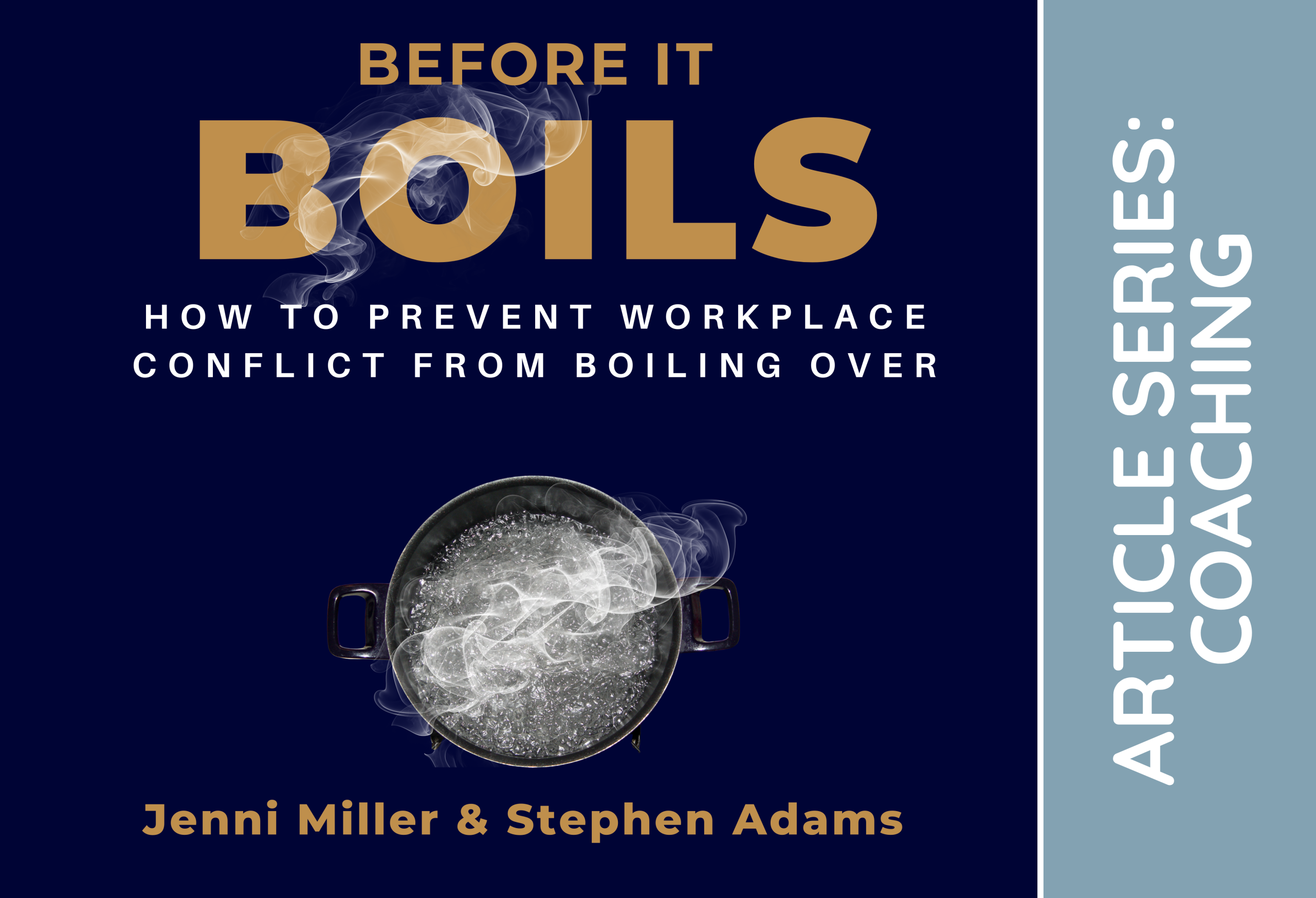
This article is adapted from ‘Before it Boils: How to prevent workplace conflict from boiling over’ by Jenni Miller & Stephen Adams (Inspiring Cultures Ltd, 2026).